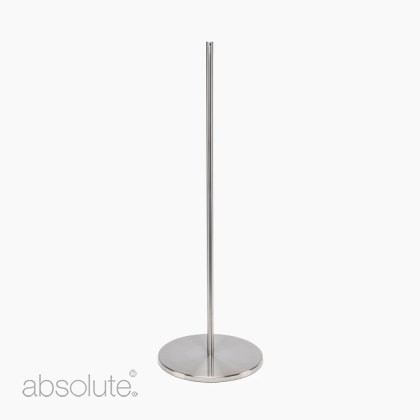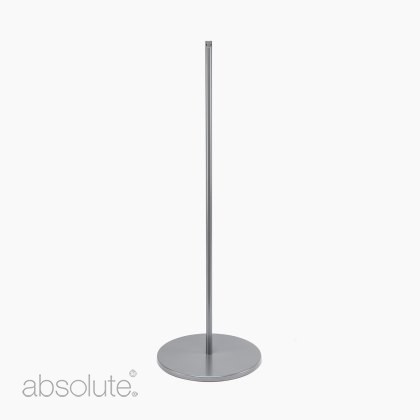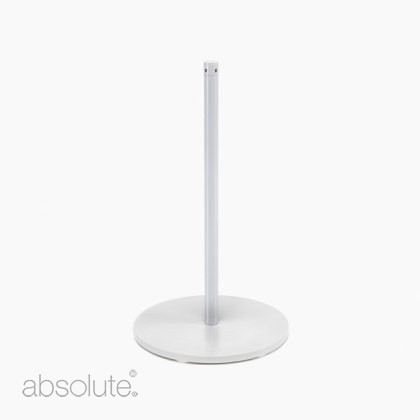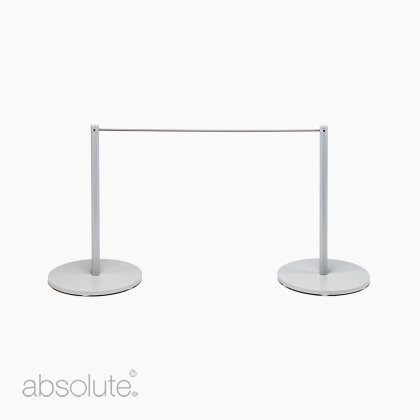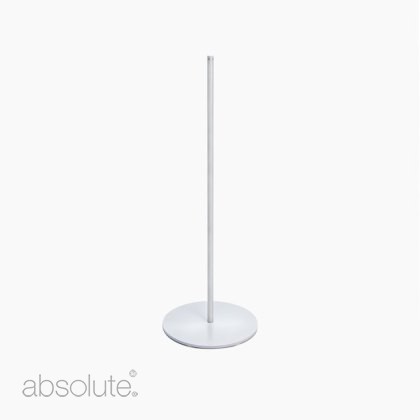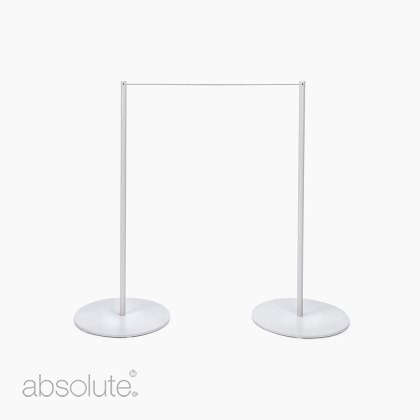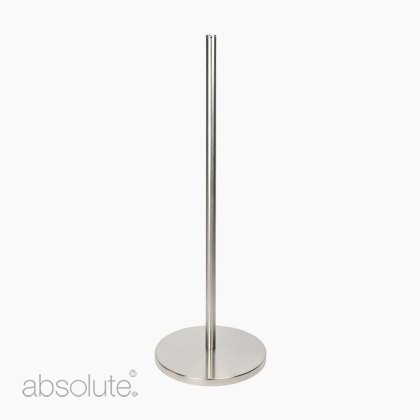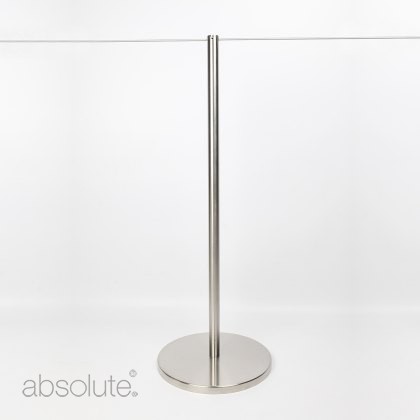
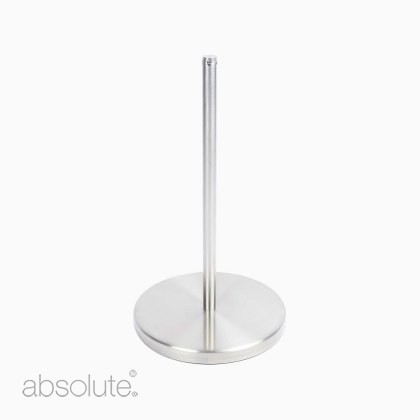
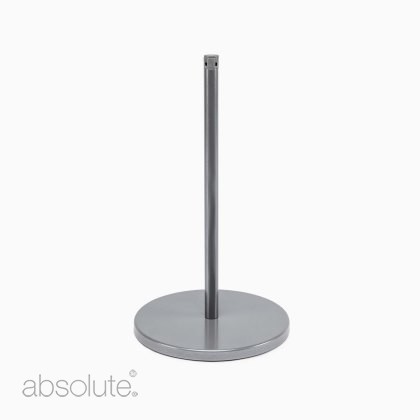

Freestanding barrier 1000mm
This is the taller version of the Absolute barrier system designed for use where the demarcation needs to be more obvious. As with the 400mm barrier, it discreetly indicates that visitors should not touch the exhibits and it’s neutral finish and clean lines sit comfortably within the museum and gallery environment, gently reminding the public of it’s presence without clashing with the display or decor. The clever bit is a stretchy cord, that fits snugly into the top of each post, drawing a neat line in the air, avoiding the distraction of that dreadful droopy rope. Because the elasticated cord makes a straight line, it blends with the architecture of the building helping the barriers to become less obvious and ensuring the artwork is the object of attention.

The large stable steel base and tall upright supports the elasticated cord and this defines restricted access, but gives to the touch. The base is cushioned with slip resistant neoprene pads to improve grip and protect polished floor surfaces. The barrier works very well as part of a permanent installation and has the flexibility to be easily re-arranged for temporary exhibits.


Dimensions & Finish
The barriers are 1000mm high with a 330mm diameter base and available in two hardwearing versions:
|
Freestanding Barrier PPC Grey 39in(1000mm) - PPC Cover Plate £145.00 |
|---|
|
Freestanding Barrier SS 39in (1000mm) - SS Cover Plate £195.00 |
|---|
Other sizes and finishes are available on request.
ACCESSORIES FOR THE 1000mm FREESTANDING BARRIER
You will of course require elasticated cord to go with your barrier layout.
Wall terminators are an excellent way to complete some barrier installations by returning the line of cord back to the wall.
You can now apply information signage directly to the top of our barriers by using one of our signage caps that will accept our range of aluminium labelholders.
If you require additional top caps then you can order them from here.
Our barriers are supplied complete with an Allen key and that is the only tool you will require to assemble them but if you need more keys, just ask.
USEFUL TIPS AND GUIDELINES
It is important to select a barrier finish that will blends well with the environment and minimises visual impact, and to assist this process our standard cord colour is grey. However in areas where it is important to draw attention to the line we can supply cord in a range of colours that will enhance the contrast. These are white, red or black.
If a floor is highly polished the barriers will need to be closer together (1.5mtrs) than a floor that has plenty of grip, in which case barriers can be spaced further apart (2mtrs).
Whenever possible barriers should be placed in a symmetrical fashion in front of an artwork as this maintains good overall visual harmony.
INSTALLATION INSTRUCTIONS FOR GREY PPC
Please scroll down for stainless steel.
Barriers are supplied in packs of two complete with an Allen key for assembly.
- Assemble the barrier by placing the large cover over the heavy black baseplate.
- Remove the bolt from the end of the upright, fit the washer onto the bolt and place it through the central hole of the base plate and cover and into the end of the upright. Tighten securely with the Allen Key provided.
- Place the barriers in position to protect the artwork allowing 1.5 to 2 metres between each. Be sure to check the cord does not ‘droop’ between barriers.
- Remove the top caps using your finger or a small screwdriver and tie a simple ‘granny’ knot in the end of the elasticated cord. Pull it very tight and cut off any excess cord close to the knot.
- Push the knot into the recess in the top of the upright with the cord exiting through one of the slots and replace the cap.
- Pull the cord tight to the next barrier with enough tension to make a straight line and push into the slots: straight across if it is a straight line or at right angles if it is at a corner.
- Repeat step 5 for the last barrier or use a wall terminator.
In an installation where the object is completely surrounded, instead of two separate knots tie the two ends together with a reef knot, pull very tight and cut off the ends. If required cut off one of the cap legs to accommodate the size of this knot.
A line of barriers can also end with the cord returning to the wall by using a wall terminator.
INSTALLATION INSTRUCTIONS FOR STAINLESS STEEL
Barriers are supplied in packs of two complete with an Allen key.
- Assemble the barrier by placing the stainless steel cover over the heavy black baseplate.
- Remove the bolt from the end of the upright, fit the washer onto the bolt and place it through the central hole of the base plate and cover and into the end of the upright. Tighten securely with the Allen Key provided.
- Place the barriers in position to protect the artwork allowing 1.5 to 2 metres between each. For the best result be sure to check that the cord does not ‘droop’ between barriers.
- When you have the desired layout, unscrew the top cap until there is a gap large enough to insert the cord. Use a small Allen key or screwdriver in the hole on the side of the cap if additional purchase is needed.
- Insert the end of the cord into the space under the cap and wrap the cord around the stem once or twice and out through one of the slots. Hold the cord in place and screw the cap down.
- For intermediate barriers, pull the cord tight to the next barrier with enough tension to make a straight line and feed the cord in through one slot, around the cap stem and out through the appropriate slot. Straight through for a line of barriers and ninety degrees at a corner.
- Repeat step 5 for the last barrier or use a wall terminator.
- When the layout is complete, gently tighten all caps to prevent ‘little fingers’ from removing them.
Note: In an installation where the object is completely surrounded, repeat step 5 with both cord ends. In this instance it is only necessary to wrap once around the stem.
A line of barriers can also end with the cord returning to the wall by using a wall terminator.