Designing Sustainable Exhibitions | Eco Friendly Practices for Museums
![]()
Summary
Designing sustainable exhibitions begins with early planning, prioritising longevity, reuse, and modular systems that minimise repeated reconfiguration. By investing in adaptable infrastructure from the outset, museums can reduce their environmental impact while saving time, reducing costs, and minimising disruption as exhibitions evolve.
The Design Museum's exhibition, Waste Age: What Can Design Do? – on view until February 2022 – set out to confront disposable culture head on, from the systems in place that encourage planned obsolescence to the realities of where waste ends up, and question what design might do to alter that concerning trajectory.
With many high-profile designers and creators involved, from Stella McCartney to the founder of Faber, Natsai Audrey Chieza, the show slow weight to the principles of the circular economy and a desire to move away from a "take-make-waste" society, into one in which products are designed for longevity, repair, and recycling.In an age where industries can ill afford to overlook their own methods of operation, galleries and museums have the opportunity to review their exhibition design choices and see where more eco-friendly practices can be applied.
The most effective sustainable choices are often the ones made in the earliest stages of the design process; whether that's planning for change and building in reuse from the start, or adopting flexible, modular components and consistent standards across the site, making it easier to evolve exhibitions while reducing impact.![]()
Plan for longevity from the start
Design for change and reuse
Sustainability in exhibition design starts by understanding that displays will naturally evolve and change over time – and making that process of change as straightforward as possible. As conservation priorities shift and access needs become clearer, galleries and museums cannot afford the time and budget to undergo a mini-refurbishment each time an exhibit needs relocating or replacing.
A practical way to reduce that cycle is to treat your hanging strategy as core infrastructure. Track systems, specified early or retrofitted with consideration, let you change placements without repeatedly drilling and repairing walls.
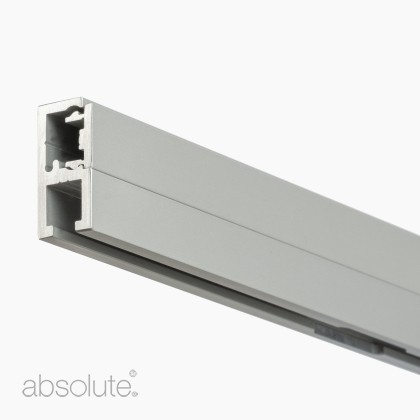
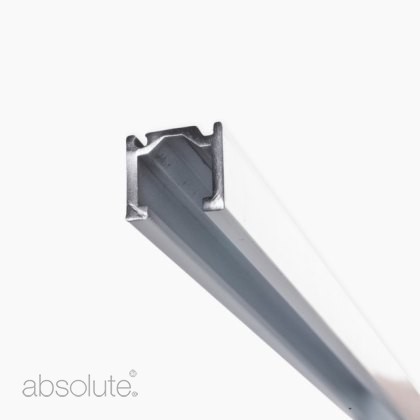
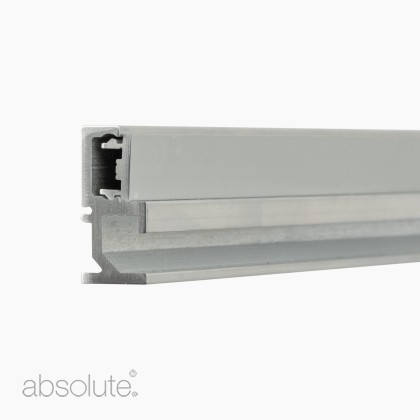
While Absolute's H Track system is designed for existing walls, the T Track is intended to be recessed at the wall and ceiling junction and is best advised for installation during construction planning. C Track, meanwhile, provides a ceiling-based fixing point when wall fixing is not possible. In each case, the principle is to create a stable, discreet line from which works can be rehung and repositioned as the exhibition evolves, without resetting the room each time.
A track system, of course, only works well if the hanging method is equally considered. In practice, that means choosing hangers that follows the frame, provide the right level of security, and allow precise alignment without repeated handling. If technicians have to fight the hardware to get a level finish, the wall and the frame take the cost over time.
For direct-to-wall hanging, Absolute's Ryman Hanger is designed to mount artworks tight to the wall with no visible fixings, with built-in adjustability and three security levels. The hangers can be used with all of Absolute's track systems, with storage hooks for screens and storage facilities, which supports a single set of hardware across storage and display rather than swapping fixings at every stage.
![]()
Make the financial case for sustainable, reusable infrastructure
Why quality and modularity support long-term sustainability
Lower-impact exhibition design works best when it also makes sense financially. Many museums are under sustained pressure to deliver more activity without a matching rise in resources, and that reality shapes every decision, from fit-out choices to day-to-day operations.
The 2024 Annual Museum Survey reported that annual turnover was up 15% on pre-pandemic levels while annual expenditure was up 20% over the same period, reinforcing the squeeze many organizations feel when planning new work.
Indeed, sustainability is often delivered through equipment that stays in service across multiple exhibitions and can be reconfigured as needs change. A track hanging system is designed to reduce repeated wall interventions and make rehangs and layout changes far less disruptive – saving time in installation and lowering the likelihood that a shift in interpretation triggers a wider refit.
Interpretation hardware follows the same logic. Label holders designed for reuse allow you to update the content without replacing the physical system, keeping change simple while maintaining a consistent presentation across a gallery.
Visitor management tools also benefit from the same approach. Systems such as Absolute's Q Line retractable barrier can be deployed for peak demand, talks, school group arrivals, or temporary closures, then retracted when the space returns to open circulation.
It's that kind of adaptability that helps teams respond quickly without resorting to single-use signage or ad hoc solutions that can damage floors or disrupt visitor routes. The barrier provides a refined alternative to traditional rope systems, using an elasticated cord and a stable base with protective pads. It is designed to be easy to reconfigure, and it can accommodate informative signage using a dedicated adapter.
![]()
A sustainable exhibition planning checklist you can use
Focus on decisions that reduce refits and extend the life of infrastructure
A useful checklist is one that prompts the right conversations early. It should cover how frequently the display is likely to change, which walls cannot be drilled, which objects will require higher security hanging, and where adjustability will save time during installation.
It should also help towards decisions on interpretive standards, such as label sizes and planning visitor routes, so queuing and protection can be handled with redeployable systems rather than temporary fixes. Finally, it should include a plan for deinstallation, covering how components will be stored, what will be held back for the next rotation, and what can be redeployed elsewhere in the building.
If you would like to download a sustainable exhibition planning checklist and explore hanging systems, label holders, and barriers that support long-term reuse, Absolute can help you review your approach and specify a solution that fits your space.
Speak with Absolute Products about your sustainable exhibition needs
Browse Track Systems
 Art Hanging System")
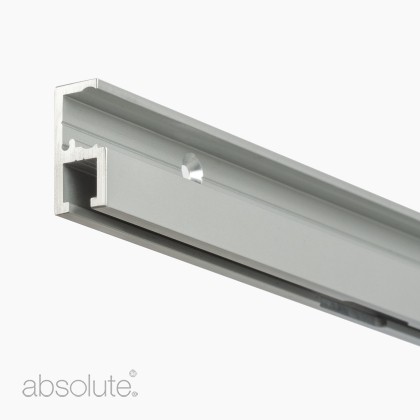 H Track (Rail) Art Hanging Systemfrom £88.00 (ex VAT)
 Art Hanging System")
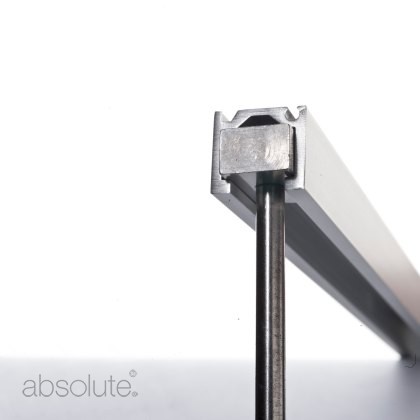 C Track (Rail) Art Hanging Systemfrom £58.00 (ex VAT)
 Art Hanging System")
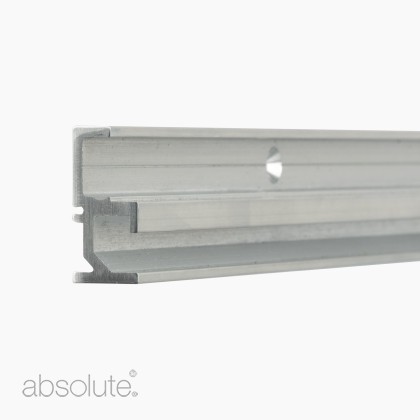 T Track (Rail) Art Hanging Systemfrom £102.00 (ex VAT)
Need Advice? We're Here to Help.
Our professional, experienced team are here to help and offer advice relating to your specific artworks or installation setting. Please contact us for further assistance.
Contact Us-
Posted by Jade Turner
3rd February 2026
FREE Delivery to the US for all orders over $1500
View Our Museum & Gallery Products Digital Brochure