Small Space, Big Impact: Maximising Limited Gallery Areas
![]()
Summary
Small gallery spaces don’t have to limit curatorial ambition. Using the Picture Room at Sir John Soane’s Museum as inspiration, this blog explores how thoughtful spatial planning, adaptable track hanging systems and disciplined labelling conventions can transform compact rooms into clear, high-impact exhibition environments.
At 13 Lincoln’s Inn Fields, London, one of the most instructive lessons in exhibition planning sits inside a remarkably compact room.
The Picture Room inside Sir John Soane’s Museum measures a mere 13 by 12 feet – but, improbably, there’s enough space to hang 118 paintings. A substantial collection, from Hogarth, Canaletto, Turner and Piranesi to name just a handful of the artists whose work features, large enough for a room three times that size.
What should result in visual chaos is a space shaped by structure, sequence and careful control of the visitor journey.
For curators and exhibition designers working in smaller galleries and museums, the challenge is all too familiar. Limited floor and wall space, in which every square metre counts, and the quest to create an environment where both the artwork and patron have enough room to breathe.
The strongest outcomes typically arrive from combining adaptable art hanging systems with disciplined, unobtrusive labelling conventions. And, when those elements are planned with expertise, smaller galleries can present ambitious narratives with clarity and confidence.
![]()
Small galleries can deliver exceptional exhibitions
Thoughtful planning turns constraints into strengths
Mixed-use environments often appear stable when interpreted as a floor plan, but behave differently during peak times. The quiet weekday morning can quickly become a crowded lunchtime corridor; a university building can oscillate between open days, conferences, exam season, and graduation.
Planning a display in such settings starts with understanding behaviour.
Where do people naturally cut corners? Where do they slow down to read a sign, wait for a lift, or gather before a lecture? Which route becomes a shortcut when it rains outside? It’s those natural human patterns that decide where you need protection and what kind of information presentation will actually be viewed.
In non-specialist settings, subtle cues do plenty of heavy lifting.
A clearly defined boundary changes visitor behaviour without making the space feel overly supervised. A label that sits at a readable angle stops visitors from leaning in and crowding an object; a gallery hanging system that keeps artworks stable and aligned helps a display feel intentional, even when the space around is lively and engaged.
The most practical approach is to plan for “change moments” – the times when staff reset furniture, switch from daytime public access to evening events, or rearrange a foyer for a ceremony.
Importantly, your infrastructure needs to stay intact, even when the settings around it are constantly changing.
This is where flexible barriers, modular signage and adaptable hanging systems can make all the difference between a display that works and one that constantly needs intervention.
Spatial strategy 101
Define movement, sightlines and density
In small galleries, layout oversights can be costly as there is less room to absorb them. The first stage is to develop a clear picture of visitor movement and viewing positions within the gallery space.
Curators and designers should identify where people pause, where they turn, where queues form, and where groups naturally gather. Once those patterns are mapped out, display density can be controlled with purpose.
Sightlines are particularly important in confined rooms; a visitor should be able to understand the structure of an exhibition at a glance, then move through it without backtracking or bottlenecks.
Typically, that requires balancing wall-mounted artwork with selected focal points – as opposed to filling every available surface. While not to be discouraged, a higher accumulation of exhibits needs to be supported by orderly hanging lines, consistent label positioning and disciplined spacing between interpretive elements.
When space planning is handled effectively, product choices become easier. The right hanging and labelling systems then reinforce the exhibition logic rather than competing with it.
![]()
Track systems to increase flexibility
Choose the right rail for the wall, ceiling and programme
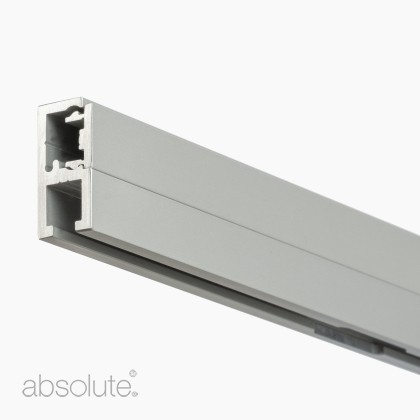
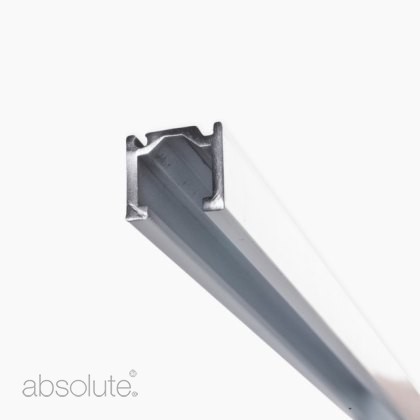
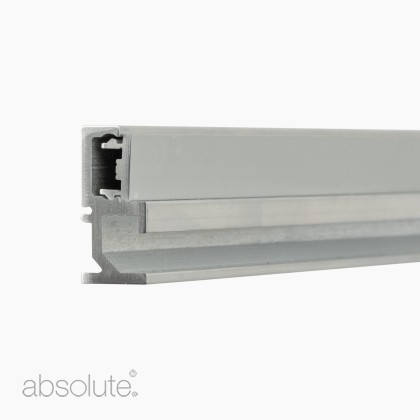
For smaller museums and galleries that change displays frequently, track hanging systems are often the most practical foundation. They reduce repeated drilling, support faster rehangs, and allow fine adjustment as shows develop.
Absolute’s H Track is an excellent option for existing walls where curators want a discreet, high-level fixing point and a clean finish. It suits projects in a constant state of flux and changeover, leaving no visible markings on finished surfaces. In day-to-day exhibition work, adaptability is a key feature that saves preparation time, helping teams refine spacing and alignment once exhibits are in place.
Where a project is in the design or refurbishment phase, T Track offers a more integrated architectural pathway, designed to be recessed at the junction of wall and ceiling, creating a flush visual transition that creates a quieter interior language. In compact galleries, reduced visual interruption can make the room feel more open and ordered.
For spaces where wall fixing is not possible, C Track provides a ceiling-based alternative and is particularly useful when historic wall materials or sensitive panels need to be preserved. In smaller heritage settings, that can be the difference between a feasible display plan and one that compromises the building fabric.
Three options, the same core advantage. Curatorial teams gain precise control over placement while keeping infrastructure discreet. In smaller gallery spaces, that combination can have a significant impact.Keep information clear without crowding objects
Labelling that supports interpretation
As displays naturally become denser in a smaller museum or gallery, interpretation can quickly feel disorganised.
Labels multiply unnecessarily, formats become inconsistent, and the visual rhythm starts to feel clumsy. In small spaces, this failing can feel amplified. The answer is not less information – instead, curators and designers require a labelling system that works in harmony with the exhibits and the space in which they inhabit.
Absolute’s Label Holder range is designed to overcome such challenges, with slim aluminium-backed presentation and options for low-reflect acrylic covers to improve readability under gallery lighting. Consistency across orientation, mounting height and spacing helps visitors process information faster, which is essential when several works sit within a short viewing distance.
![]()
Where cases are used heavily, the Display Case Label Holder presents content at 45 degrees and keeps interpretation easy to read inside or outside case lines. Meanwhile, the Freestanding Label Holder adds flexibility for nearby object information without introducing bulky supports, making it useful in mixed layouts where wall labels alone are not sufficient.
For display shelves, the Shelf Edge Label Holder can be particularly effective in compact galleries. By moving text into a single line along the shelf edge, it frees shelf surfaces for artefacts and reduces visual competition between labels and objects. On high-density displays, that simple shift can bring immediate order.
The Pinnacle Freestanding Label Holder collection is another refined, super flexible option, especially where a discreet, premium label presentation is required in controlled visitor-facing spaces. With low-reflect covers, a clear 45 degree reading angle, and a variety of heights, label sizes and custom options available, they provide legibility with a minimal footprint.
Design for multiple changeovers
Reusable systems protect time, budget and finishes
Small institutions often work with skeleton crews in tight installation windows. As such, systems that are reusable and modular make a measurable difference over the life of a programme, reducing labour during rehanging, lowering replacement demand, and helping maintain a consistent visual standard across changing exhibitions.
Importantly, track-based hanging systems limit repeated surface intervention; reusable label holders allow straightforward content updates without replacing entire assemblies, while freestanding and surface-mounted gallery information and signage products provide further control where display layouts vary from show to show.
Practical flexibility also aligns with wider sustainability aims. Reuse reduces single-use materials and avoids unnecessary disposal of short-life display components. For organisations managing constrained budgets, operational efficiency is valuable in its own right.
Manage museum floor space with subtle guidance tools
Flexible barriers and signage can prevent congestion
No matter the size of the gallery, popular exhibits will naturally attract dwell time, causing narrow points to become blocked. Thoughtful, well-placed guidance tools can prevent circulation and visitor flow issues without creating a harsh or overmanaged atmosphere.
Freestanding barriers and compatible signage elements can be reconfigured quickly as visitor behaviour changes across a run; valuable in cases where a previously unpopular exhibit gains sudden attention, or when foot traffic is heavier on certain days. Reusable guidance infrastructure allows teams to respond in real time while preserving a clean visual environment.
When integrated with discrete labels and information systems, visitor flow tools support both comprehension and movement. People can find the narrative path, read comfortably, and maintain an appropriate distance from sensitive objects without constant staff intervention.
![]()
Create a singular visual system
Cohesion creates calm in small gallery spaces
The most successful small galleries treat hanging, interpretation and flow management as one coordinated display language. Track systems, label holders, case labels and guidance elements should look and behave like parts of the same system. When finishes, proportions and mounting logic are aligned, even dense exhibitions feel controlled and confident.
For curators and designers working within limited spaces, the goal is to organise more effectively – so that every square metre works harder, and each artwork is given the room to be viewed and enjoyed as intended.
If you are planning an exhibition in a compact gallery and want practical guidance, download our small gallery planning worksheet and explore Absolute’s track hanging and labelling solutions. If you would like project-specific advice, our team can help you map a layout that is flexible, legible and ready for use.
Browse Track Systems
 Art Hanging System")
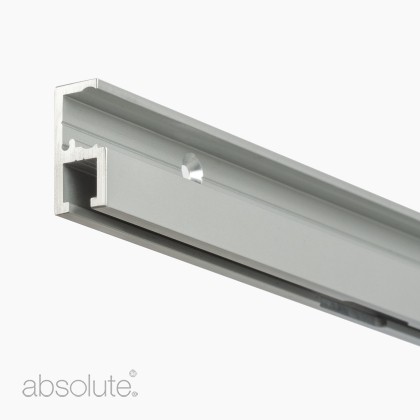 H Track (Rail) Art Hanging Systemfrom $129.36 (ex VAT)
 Art Hanging System")
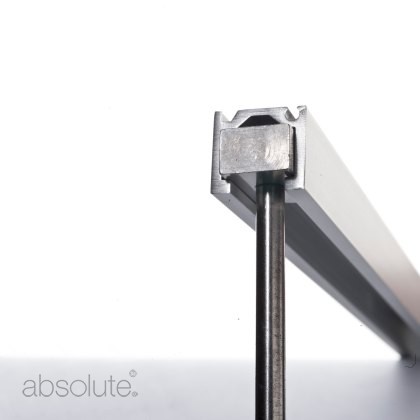 C Track (Rail) Art Hanging Systemfrom $85.26 (ex VAT)
 Art Hanging System")
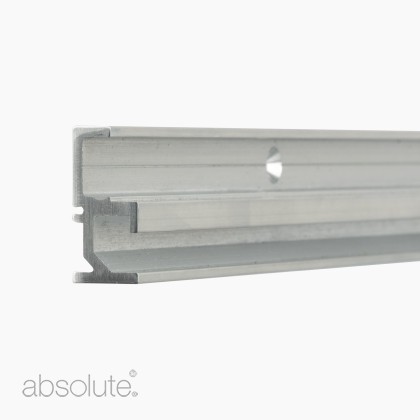 T Track (Rail) Art Hanging Systemfrom $149.94 (ex VAT)
Barrières directionnelles
 Art Hanging System") C Track (Rail) Art Hanging Systemfrom $85.26 (ex VAT)
C Track (Rail) Art Hanging Systemfrom $85.26 (ex VAT) Art Hanging System") T Track (Rail) Art Hanging Systemfrom $149.94 (ex VAT)
T Track (Rail) Art Hanging Systemfrom $149.94 (ex VAT) Art Hanging System") H Track (Rail) Art Hanging Systemfrom $129.36 (ex VAT)
H Track (Rail) Art Hanging Systemfrom $129.36 (ex VAT)Need Advice? We're Here to Help.
Our professional, experienced team are here to help and offer advice relating to your specific artworks or installation setting. Please contact us for further assistance.
Contact Us-
Posted by Jack Turner
24th February 2026
FREE Delivery to the US for all orders over $1500
View Our Museum & Gallery Products Digital Brochure